

Updated for 2026.
Even though the Toyota Prius was introduced in Canada well over a decade ago, the same question always pops up during winter: Is a used one really worth considering, or are you just taking someone else’s headache of a very expensive battery? In fact, the Prius was launched in Japan way back in 1997; was introduced into North America for the 2000-2001 model year; and even before 2011, one million Priuses had already been sold in the USA, while the numbers in Canada kept increasing along the way. Five generations on, today’s Prius not only saves gas but has even earned the title of 2024 World Car Design of the Year Award.
It is precisely for this reason that “should I buy a used Prius” is not one question. A used Prius can either be a 23-year-old sedan whose battery days are numbered or a two-year-old hatchback with full factory warranty. These cars have nothing in common but a logo. Rather than providing a simple answer of “yes” or “no,” this article will discuss how each Prius generation differs from its predecessors, identify any real or perceived risks, determine the price of a used Prius in Canada in 2026 and list the few factors specific to buying a Prius in Canada in particular.
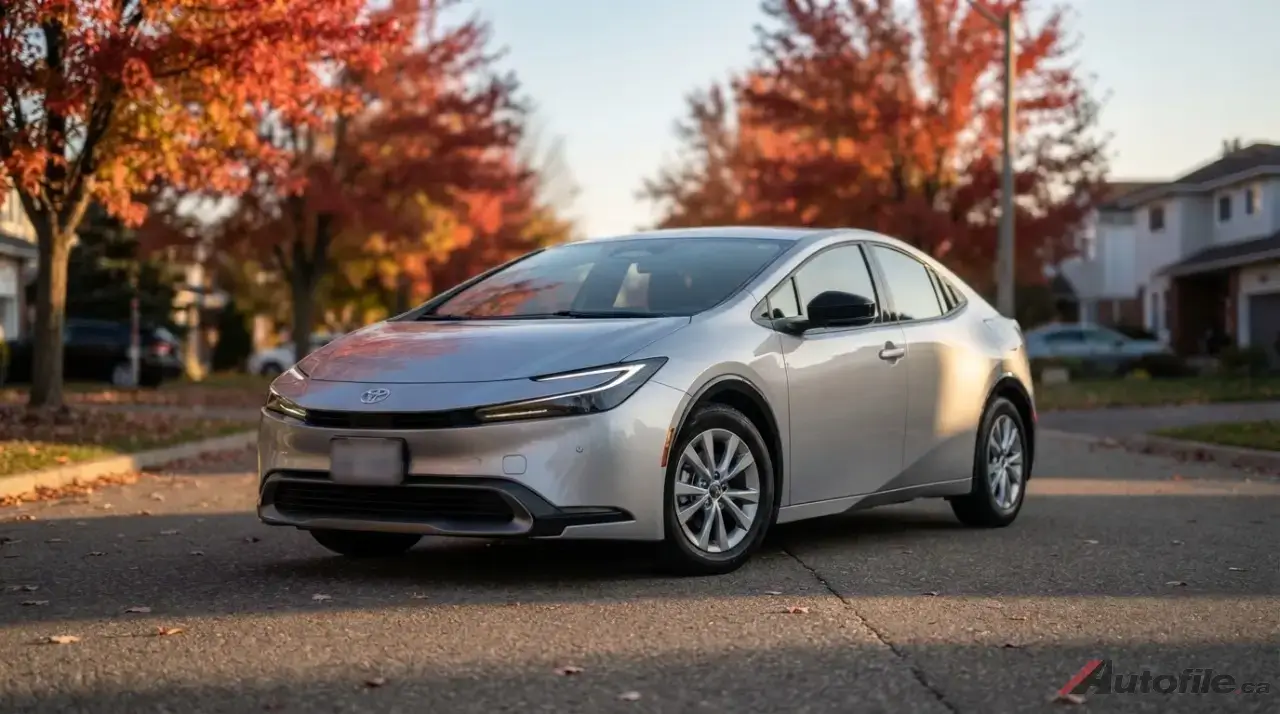
The Short Version
- A used Prius in 2026 spans roughly $4,500 for a high-mileage second-generation hatchback to $35,000+ for a low-mileage, nearly new fifth-generation car still under warranty.
- The biggest myth around this car is that the hybrid battery “dies” and turns the Prius into scrap. In practice, a tired battery doesn’t strand you the way a dead EV battery would — it just makes the car less efficient and a bit slower, with the gas engine picking up the slack.
- Every generation has its own weak point: second-gen Prius had headlight and inverter-cooling issues, third-gen has the well-documented head-gasket problem, fourth-gen mostly just had windshield cracking complaints, and fifth-gen has been more about software recalls than mechanical failures so far.
- The single most useful document you can get before buying isn’t a CARFAX report — it’s a proper hybrid-system health check, plus (for 2010–2015 cars specifically) confirmation of how the EGR system and cooling system have been maintained.
- Canadian winters add their own checklist items: rust and undercarriage corrosion from road salt, cold-weather range loss on plug-in models, and whether AWD-e is worth chasing.
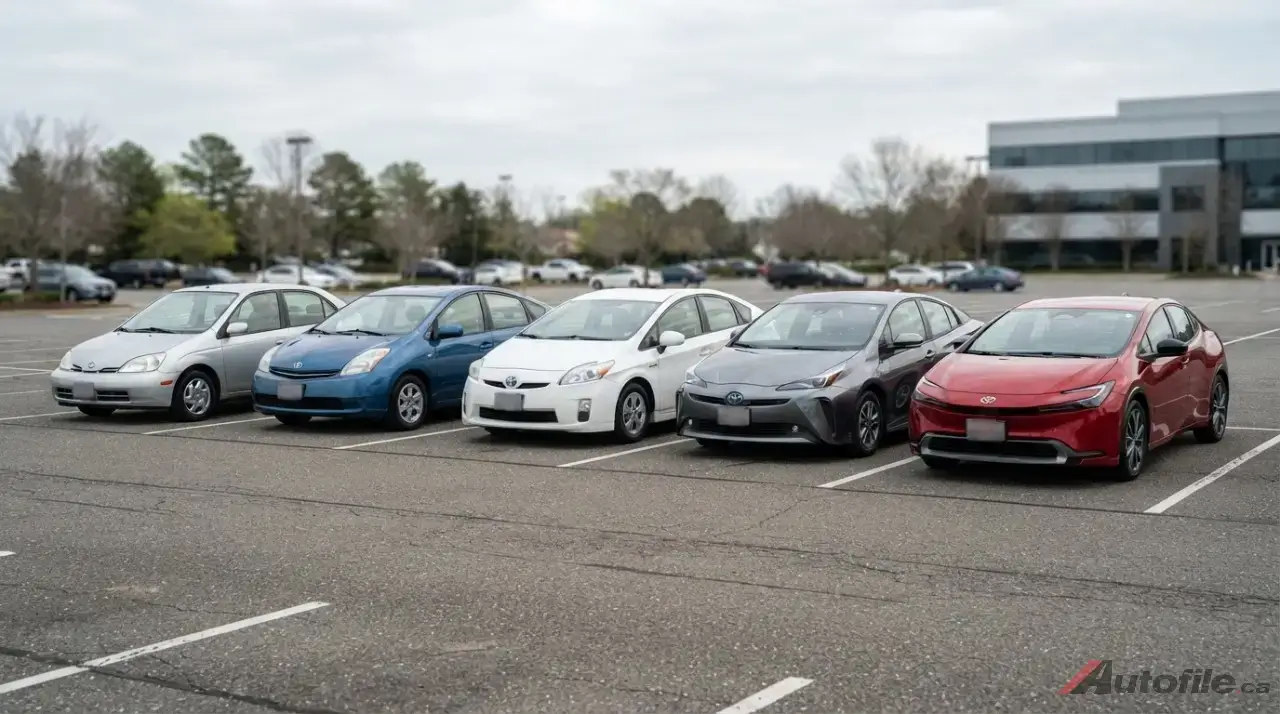
Five Generations at a Glance
| Generation | Chassis Code | Model Years (North America) | Body Style | Combined Fuel Consumption |
|---|---|---|---|---|
| I | NHW11 | 2001–2003 | 4-door sedan | ~5.7 L/100 km |
| II | NHW20/XW20 | 2004–2009 | 5-door hatchback | ~5.1 L/100 km |
| III | ZVW30/XW30 | 2010–2015 | 5-door hatchback | ~4.7 L/100 km |
| IV | XW50 | 2016–2022 | 5-door hatchback | ~4.5–4.2 L/100 km |
| V | XW60 | 2023–present | 5-door liftback | ~4.8–4.1 L/100 km |
First generation (2001–2003) was essentially a technology demonstration that Toyota decided to sell to the public. Built on the NHW11 platform with a 1.5L engine and a modest electric motor, it made a combined 97 horsepower and was rated at roughly 5.7 L/100 km — genuinely remarkable for 2001.
Second generation (2004–2009) is the car most people picture when they hear “Prius” — the wedge-shaped hatchback that made hybrids mainstream. This is also the generation with the longest list of small, irritating electrical quirks, even though the core mechanicals proved extremely durable.
Third generation (2010–2015) was the efficiency king of its era — the first mass-market car sold in North America to break below 5 L/100 km combined. It’s also the generation carrying the single most expensive, most talked-about mechanical issue in Prius history, which we’ll get into below.
Fourth generation (2016–2022) is where the Prius grew up: Toyota Safety Sense arrived as standard equipment, all-wheel drive (AWD-e) became available starting with the 2019 model year, and reliability data from this generation is consistently strong.
Fifth generation (2023–present) is a dramatic redesign — genuinely quick for a Prius (0–100 km/h in about 7.2 seconds versus 9.8 for the previous generation) and still remarkably efficient, down to roughly 4.1 L/100 km on the front-wheel-drive base trim.
Worth knowing: Toyota also sold the wagon-like Prius v (roughly 2012–2017, more cargo room, less common on the used market) and the subcompact Prius c (roughly 2012–2019, smaller and cheaper than the standard car). Both are worth a look if space or budget is your priority, but the rest of this guide focuses on the mainline Prius hatchback and its plug-in sibling.
What Actually Breaks: Reliability by Generation
Generation I (2001–2003): A curiosity, not a daily driver
Since any remaining examples are now over 23 years old, age alone becomes the factor to consider. It has been documented that Toyota had a recall of around 52,000 vehicles in 2011 due to a loose pinion-shaft nut in the power steering which could lead to reduced steering assist, especially when turning left. In a separate report, drivers have reported worn steering torque sensors which would result in a shake while steering. Drivers also experienced brake hesitation while pressing down on the brakes during an abrupt stop.
Conclusion: Collectible or a good candidate for a restoration project but definitely not something that one could purchase and drive on a regular basis due to its age and lack of available parts.
Generation II (2004–2009): The car that made “Prius” a household name — with cranky headlights
This is where sales genuinely took off, and the powertrain fundamentals proved themselves — it’s not unusual to find these still running on their original engine and battery well past 300,000 km.
- Headlights. By far the most common complaint on this generation is headlights turning off randomly, on one or both sides. It’s heavily concentrated in the 2005–2007 model years, each of which logged well over a thousand complaints to safety regulators (over 2,000 in 2007 alone), with headlight failures accounting for more than half of them.
- Inverter coolant pump. A separate coolant pump cools the inverter, and it’s a known weak point — Toyota issued a recall covering it. If the pump fails unnoticed, the inverter can overheat and cascade into a wider hybrid-system fault. Owners sometimes half-jokingly call this chain of failures the “triangle of death” — a nickname for one of the scarier, though thankfully uncommon, problems on this generation.
- Higher oil consumption at high mileage — ordinary engine wear rather than a defect.
- Inaccurate fuel gauge readings, particularly flagged on 2006 models — fixed with recalibration, no formal recall was issued.
Bottom line: Excellent value, especially a well-kept 2008 or 2009 example, by which point Toyota had ironed out most of the early quirks. At 15+ years old, budget for suspension wear items and possibly a battery — but the core mechanical package has proven itself over time.
Generation III (2010–2015): The efficiency champion with an expensive asteris

The redesign brought a larger 1.8L engine and a combined rating near 4.7 L/100 km — at the time, the most efficient mass-market car sold in North America. It’s also responsible for the most significant and best-documented mechanical failure in the model’s history.
The head-gasket problem. The 2ZR-FXE engine’s exhaust gas recirculation (EGR) system tends to clog with carbon deposits over time. That throws off the air-fuel balance, raises in-cylinder pressure, and eventually the head gasket fails. The classic symptom is a rattling noise on cold start that smooths out once the engine warms up (as coolant that leaked onto the spark plugs burns off), along with a gradual, hard-to-explain loss of coolant with no visible leak. Independent hybrid specialty shops that track this closely put the peak failure window at roughly 240,000–320,000 km, though isolated cases show up earlier. Repairs aren’t cheap — bills can run into several thousand dollars depending on whether the engine itself needs replacing.
Here’s the detail a lot of buyers miss: Toyota revised the piston design for the 2014 model year and the piston rings for 2015, and failure rates dropped noticeably afterward. That makes a 2014 or 2015 example a meaningfully safer bet than a 2010–2013 car, even though they look identical on paper.
There was also a separate, less common issue on 2010–2014 cars involving thermal stress on transistors in the motor-generator control module, related to software calibration — addressed with an ECU reflash.
Bottom line: The fuel economy is outstanding, but for this generation the EGR and head-gasket service history matters more than mileage. If you’re shopping a 2010–2013 car, that history should be priority number one — ahead of trim level, ahead of interior condition, ahead of almost anything else.
Generation IV (2016–2022): Grown-up and well-behaved
This generation brought the full Toyota Safety Sense suite as standard (more on that below) and, starting with the 2019 model year, an available AWD-e all-wheel-drive system — genuinely useful for Canadian winters.
Known issues are comparatively minor:
- Windshield cracking complaints, concentrated mostly on 2016 models.
- A 2016–2017 recall related to the parking brake.
- Otherwise, this generation consistently earns strong marks from independent reliability trackers and is considered one of the most trouble-free in the Prius lineup.
Bottom line: For a lot of buyers, this is the sweet spot — modern driver-assist technology, a well-proven hybrid system, and (thanks to a seven-year production run) plenty of used inventory to choose from.
Generation V (2023–2026): Too new for a long track record, and that’s mostly good news
A radical redesign, a genuinely sportier character, and still efficient — up to roughly 4.1 L/100 km on the base front-wheel-drive trim. The engine grew to 2.0L, and all-wheel drive is available right from launch rather than arriving mid-cycle.
Because the generation is only a few years old, there isn’t a long history of age-related wear issues yet — but there is a concrete recall history:
- 2023 model year: roughly 13,000 vehicles recalled over a software glitch in the hybrid battery system that could theoretically cause a loss of drive power while underway; fixed with a free software update.
- 2023–2025: a software recall affecting the rearview/panoramic camera display freezing — this campaign spans several Toyota, Lexus, and Subaru models, not just the Prius.
- 2023–2026 Prius (plus 2023–2024 Prius Prime and 2025–2026 Prius Plug-in Hybrid): a recall for water intrusion at the rear door switch, which could theoretically cause a short circuit and an unlocked door popping open while driving. This one affected roughly 141,000 vehicles, with remediation still rolling out into 2026.
Despite that list, overall complaint volume relative to sales remains low, and independent reliability trackers have rated the 2023–2025 model years “good” — generally in the mid-to-high 70s out of 100 on the scales that use that kind of scoring.
Bottom line: A 2023 or 2024 model with some mileage already on it and every recall confirmed closed is arguably the strongest reliability bet in the whole lineup — you’re just paying close to new-car money for that confidence.
The High-Voltage Battery: The Myth, and the Reality
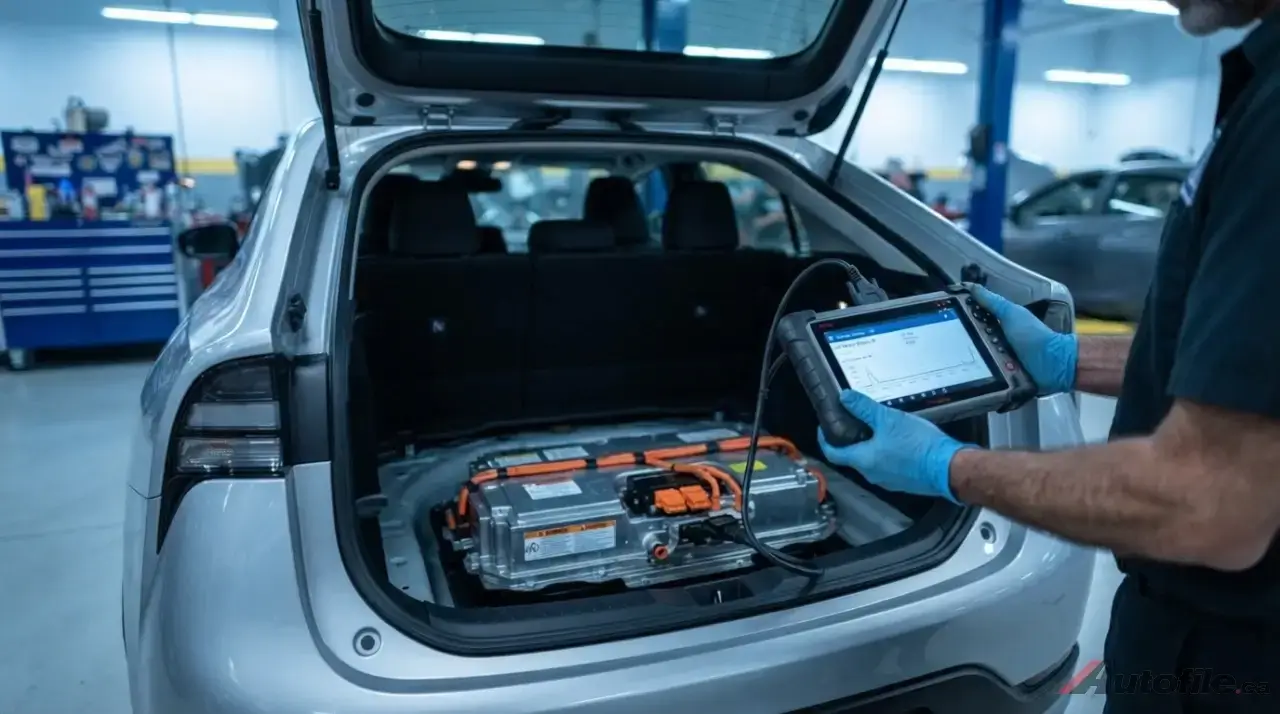
Almost every conversation about a used Prius eventually circles back to one question: what’s the battery actually like? Let’s break it down properly.
How it really ages
Unlike a full electric vehicle, a Prius doesn’t strand you when the battery weakens. As cells degrade, the electric motor contributes less assistance to the gas engine — acceleration feels flatter and fuel economy creeps up — but the gas engine simply does more of the work. The car doesn’t die at the side of the road; it gradually becomes a slightly less efficient, slightly heavier ordinary car.
How long it actually lasts
The “battery dies in five years” fear is almost always overblown. Independent analysts put the average realistic lifespan of a Prius at around 13 years and roughly 280,000 km — and the battery is rarely the thing that ends that lifespan first. It’s genuinely common to find well-documented examples exceeding 300,000–400,000 km on the original battery pack, particularly among taxi and rideshare vehicles that rack up kilometres quickly.
Toyota Canada backs this up with warranty coverage: hybrid-related components carry an 8-year/160,000 km warranty, while the hybrid battery specifically gets 10 years or 240,000 km, whichever comes first — a coverage level that was actually extended from an earlier 8-year/160,000 km hybrid battery warranty as Toyota’s confidence in the technology grew.
What replacement costs in 2026
If a battery genuinely needs replacing, there are a few paths, with a wide range in price:
| Option | Approximate Cost (CAD) | Warranty | Expected Life |
|---|---|---|---|
| New OEM pack from a dealer, installed | $4,800 – $7,500 | Usually 1–2 years on labour | 240,000+ km |
| Reconditioned pack from an independent hybrid specialist | $1,400 – $3,300 | A few months to 3–5 years, depending on the shop | 130,000–190,000 km |
| Used pack from a salvage yard | $1,100 – $2,900 | Minimal or none, typically | Depends on the donor vehicle |
The price gap basically reflects the difference between a full set of brand-new cells and a rebuild that replaces only the weakest modules in an existing pack. For a car you plan to keep for years, a reconditioned pack with at least a three-year warranty is usually the sensible middle ground — noticeably cheaper than dealer pricing without the total unknown of a no-warranty salvage unit.
How to check the battery before you buy
There’s no way to eyeball battery health — you need actual diagnostics. Hybrid specialists use tools that read voltage and internal resistance on each individual module, not just a generic trouble code. There are also inexpensive Bluetooth OBD-II adapters paired with hybrid-specific apps that give a rough picture from your phone — not a substitute for a professional check, but a fast way to rule out an obviously troubled car before you spend money on a proper inspection. A useful secondary clue: compare the fuel economy the seller or trip computer reports against the rated figure for that year and trim. A meaningful gap is worth investigating further.
Don’t confuse it with the “regular” battery
Like any car, a Prius has a separate, ordinary 12-volt battery that powers accessories and starts up the hybrid system — it has nothing to do with propulsion. It lasts a typical 3–6 years and costs a small fraction of what the high-voltage pack does. The problem is that even mechanics occasionally mix the two up: the car “won’t start” because of a plain dead 12-volt battery, and a nervous buyer assumes the worst about “the hybrid battery” and walks away from — or haggles hard over — a car with a hundred-dollar problem.
Fuel Economy by Generation
Fuel economy is one of the few Prius specs that has only ever gotten better:
| Generation | Combined Fuel Consumption |
|---|---|
| I (2001–2003) | ~5.7 L/100 km |
| II (2004–2009) | ~5.1 L/100 km |
| III (2010–2015) | ~4.7 L/100 km |
| IV (2016–2022), standard trims | ~4.5 L/100 km |
| IV (2016–2022), Eco/L Eco trims | ~4.2 L/100 km |
| V (2023–present), front-wheel drive | ~4.1 L/100 km |
| V (2023–present), upper trims | ~4.5 L/100 km |
| V (2023–present), all-wheel drive | ~4.8 L/100 km |
One nuance worth knowing if you’re comparing old listings: fuel consumption testing methodology got noticeably more conservative around 2008. Some older references to second-generation Prius efficiency use pre-2008 numbers that look better than they would under today’s testing — the figures above reflect the more realistic, modern-methodology equivalent. Real-world consumption tends to track close to these ratings with gentle driving; highway speeds above 110–120 km/h and cold winter conditions both push actual consumption noticeably higher, which is true of every hybrid, not a Prius-specific flaw.
Prius Prime and Plug-in Hybrid: The Version You Can Charge

There’s a separate branch of the family that adds a much bigger battery and genuine short-range electric-only driving, and it’s gone through three distinct generations over about 12 years:
First generation — Prius Plug-in Hybrid (2012–2015). Based on the third-generation platform. A 4.4 kWh battery delivered roughly 18 km of electric-assisted range in a mode that blended with the gas engine rather than running purely electric. Combined output was 134 horsepower.
Second generation — Prius Prime (2017–2022). Based on the fourth-generation platform, with an 8.8 kWh battery good for roughly 40 km of electric range. Oddly, combined output actually dropped slightly to 121 horsepower — the extra battery weight took a small bite out of performance compared to the standard hybrid of the same generation.
Third generation — Prius Prime, later renamed Prius Plug-in Hybrid (2023–present). Based on the current fifth-generation platform, and a genuine leap forward: a 13.6 kWh battery good for up to roughly 71 km of electric range on the base SE trim (about 63–64 km on higher trims with larger wheels), combined output up to 220 horsepower, and a 0–100 km/h time of about 6.6 seconds. Starting with the 2025 model year, Toyota dropped the “Prime” branding in favour of the simpler “Prius Plug-in Hybrid” name, aligning it with the rest of the electrified lineup.
As with any plug-in hybrid, cold weather cuts real-world electric range noticeably — typically 20–30% below the rated figure — which is a characteristic of the technology generally, not something specific to Toyota.
A note on rebates. If you’re hoping a used Prius Prime qualifies for a government incentive, it’s worth setting expectations early: both the federal government’s incentive programs (the now-closed iZEV program and its 2026 successor, the Electric Vehicle Affordability Program) apply only to new vehicle purchases or leases, not used ones. Some provinces have offered their own used-EV incentives at various points, but these programs have been unusually unstable over the past couple of years — paused, cancelled, and relaunched in different forms — so check your specific province’s current status directly before assuming any rebate applies.
Safety Tech: How the Prius Learned to Watch the Road
Toyota Safety Sense (TSS) launched across the Toyota lineup in 2015, and the Prius picked it up with its fourth-generation redesign:
- 2016–2018 (early Gen IV): A foundational safety package — pre-collision braking, lane-departure warning with steering assist, automatic high beams, and adaptive cruise control.
- 2019–2022 (later Gen IV): Upgraded to TSS 2.0, adding road-sign recognition and true lane centring (Lane Tracing Assist) rather than just a departure warning.
- 2023 (Gen V launch): Started out with TSS 2.0.
- 2024–present (Gen V): Upgraded again to TSS 3.0, with improved camera and radar performance, better intersection support, and Proactive Driving Assist, which gently helps with steering and braking in situations that look like they could turn into a problem.
If active driver-assist features are a priority, know that any 2010–2015 (third-generation) Prius predates this system entirely — TSS simply didn’t exist yet. Anything from 2016 onward gets at least some version of it.
Winter Readiness: Cold Weather, AWD-e, and Block Heaters
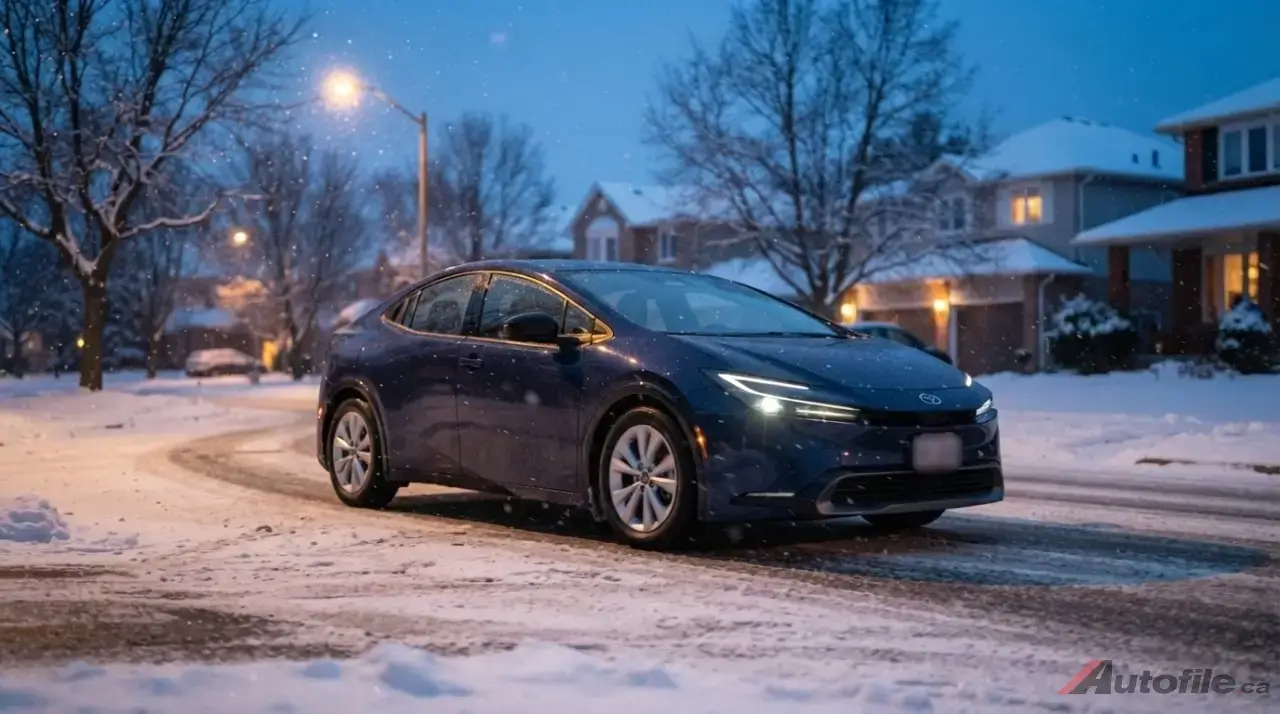
This is the part a lot of Prius write-ups skip entirely, and it matters a great deal north of the border.
Cold-weather efficiency. Like any hybrid, a Prius is noticeably less efficient in winter — the gas engine has to run more to generate cabin heat and to warm the battery and hybrid components to their optimal operating temperature, and the battery itself is less effective when cold. Expect real-world fuel consumption to run meaningfully higher than the rated figures once temperatures drop well below freezing, and expect Prius Prime/Plug-in Hybrid electric range specifically to fall by roughly 20–30%.
AWD-e. Since the 2019 model year on Gen IV (and standard availability from launch on Gen V), Toyota has offered an electric all-wheel-drive system on the Prius, where a separate rear motor engages at low speeds and in slippery conditions. It’s not a substitute for good winter tires, but it’s a genuine advantage for buyers in snowier parts of the country, and it commands a real price premium on the used market — worth deciding upfront whether you actually need it or whether a front-wheel-drive car on proper winter tires covers your situation just as well.
Block heaters. Speaking of cold starts — Toyota issued a recall covering certain block heater kits installed on some vehicles (including Prius models), where the heater cable’s heat protection was insufficient and could be damaged by high engine-bay temperatures, creating a short-circuit and overheating risk while plugged in. If you’re buying a car that came with a factory or dealer-installed block heater, it’s worth confirming this recall (if applicable to that specific kit) has been addressed.
Road salt and corrosion. This one isn’t Prius-specific, but it’s non-negotiable for a Canadian used-car purchase: get underneath the car, or have a mechanic do it, and look hard at the subframe, brake and fuel lines, and rear suspension mounting points for rust. A car that spent its life in Alberta or coastal B.C. can look dramatically better underneath than an identical car that wintered in Ontario, Quebec, or Atlantic Canada. Toyota’s 60-month, unlimited-kilometre rust perforation warranty (covering holes rusted through original body sheet metal, though not surface rust) is worth checking against the car’s age, but by the time a Prius is old enough to be a realistic used purchase, that coverage has usually expired — so a hands-on inspection matters more than the warranty booklet.
What a Used Prius Costs in Canada in 2026

These are approximate ranges based on current listings across the country — treat them as a starting point for negotiation, not a fixed price list:
| Generation & Years | Typical Odometer for the Age | Approximate Price (CAD) |
|---|---|---|
| Gen II, 2004–2009 | 150,000–250,000 km | $4,500 – $11,000 |
| Gen III, 2010–2012 | 100,000–260,000 km | $7,500 – $16,000 |
| Gen III, 2013–2015 | 80,000–180,000 km | $11,000 – $20,000 |
| Gen IV, 2016–2018 | 60,000–210,000 km | $16,000 – $27,000 |
| Gen IV, 2019–2022 | 30,000–140,000 km | $19,000 – $29,000 |
| Gen V, 2023–2025 | 15,000–65,000 km | $27,000 – $38,000 |
| Prius Prime/Plug-in Hybrid (any generation) | Varies | $13,000 – $34,000 |
The Prius holds its value unusually well compared to most of the used market — reliability reputation and steady demand keep prices firmer than you’d see on a less popular model of the same age. That’s a mixed bag depending on which side of the deal you’re on: don’t expect to steal one, but you’ll have an easier time selling it down the road, too.
With gas prices sitting around $1.60–$1.75 a litre nationally through much of 2026 (and considerably higher in provinces like Newfoundland and Labrador or B.C.), the fuel-cost gap between a Prius and a comparable non-hybrid only gets more meaningful the more you drive.
Pre-Purchase Checklist

Beyond the usual used-car basics — accident history, a CARFAX Canada report, matching VIN plates, clean title — a Prius has a few items worth checking specifically:
- A proper hybrid battery health check from a shop with real diagnostic equipment, not just a generic scan for trouble codes.
- For 2010–2015 cars, EGR system and head gasket history. Ask directly whether the EGR valve/cooler has been serviced, and listen closely for that telltale cold-start rattle.
- Open recalls. Check the VIN against Transport Canada’s recall database or ask a Toyota dealer directly — remedies are free, but only if the current or a previous owner actually had the work done.
- Rust and undercarriage corrosion, especially on any car that’s spent winters in a road-salt province — this deserves at least as much attention as the drivetrain.
- Tire condition and type. Prius models often come with specific low-rolling-resistance tires; if they’ve been swapped for generic all-seasons, real-world fuel economy may not match the rating.
- Suspension bushings and mounts, which wear a bit faster than on a comparable non-hybrid given the car’s extra weight — worth a look past 150,000–200,000 km.
- Brake feel and regenerative braking, checked on a real test drive — engagement should be smooth, without any grabbiness or hesitation.
- The 12-volt battery, just to confirm cold starts are trouble-free — and to make sure you’re not mistaking a cheap fix for a hybrid-battery problem.
- A genuine test drive covering the transition between electric and gas power — no unusual whining or grinding from the motor or inverter, and smooth handoffs between the two.
- For Prius Prime/Plug-in Hybrid, confirm the charge port works, verify the actual achieved electric range, and make sure a charging cable is included.
- Service history that doesn’t scream fleet or rideshare use — unless you’re fine with that, in which case confirm it directly and check wear on the driver’s seat, wheel, and pedals against the claimed mileage.
Best Years to Buy — and Years That Deserve Extra Scrutiny
Boiling all of the above down to a quick recommendation:
Solid bets: late second-generation cars (2008–2009), third-generation cars built after the piston and ring revisions (2014–2015), essentially any fourth-generation car — especially 2019 and newer — and any fifth-generation car with all recalls confirmed closed.
Worth extra scrutiny: first-generation cars simply due to age, 2005–2007 second-generation cars (the headlight-complaint peak), and especially 2010–2013 third-generation cars — not a hard “avoid,” but the EGR and head-gasket history needs to check out before anything else about the car matters.
None of this is a guarantee either way. These are statistical patterns across large numbers of vehicles, not a verdict on any individual car — a documented, well-maintained “risky” year will usually beat an undocumented “safe” year every time.
Buying South of the Border: Importing a Prius from the U.S.

Because U.S. listings can look cheaper at first glance, some Canadian buyers look at importing a used Prius rather than buying locally. It’s a real option, but the math has changed significantly and needs a careful, current calculation before you assume it’s a deal.
The process. U.S.-market vehicles go through the Registrar of Imported Vehicles (RIV) program. In short: the specific vehicle needs to be on Transport Canada’s admissibility list, it must be free of any open recalls (you’ll need to provide proof), it can’t be modified from its original factory condition, and it has to pass a federal RIV inspection within 45 days of crossing the border (one year for a salvage-titled vehicle).
The costs — and why they’ve changed. On top of the vehicle price, expect Canada’s 5% federal GST calculated on the converted value at the border, a flat $100 excise tax on any vehicle equipped with air conditioning (which is essentially every Prius), an RIV registration fee, and provincial sales tax once you register the car. The bigger factor as of 2026: Canada has had a 25% retaliatory surtax in place on motor vehicles of U.S. origin since April 2025, applied on top of everything else, in response to separate U.S. tariffs on Canadian-built vehicles. Depending on the specific VIN and trade-agreement eligibility, that surtax can erase most or all of the apparent savings from a lower U.S. sticker price.
The bottom line. Importing still occasionally makes sense — a rare trim, a meaningfully lower-mileage car for similar money even after fees, or a colour or configuration that’s hard to find in Canada. But treat any “it’s so much cheaper in the U.S.” comparison with real skepticism in 2026 until you’ve added up GST, the surtax, the RIV fee, and provincial tax on top of the purchase price — and confirm current rates directly with a customs broker or Transport Canada, since this is an area that’s shifted more than once recently and could shift again.
Warranty Coverage in Canada
Toyota Canada’s coverage is worth understanding on its own, separate from the battery-specific numbers above:
- Basic warranty: 36 months / 60,000 km on any part supplied by Toyota Canada.
- Hybrid-related components (battery control module, hybrid control module, inverter with converter): 8 years / 160,000 km.
- Hybrid battery itself: 10 years / 240,000 km, whichever comes first.
- Rust perforation: 60 months, unlimited kilometres, against rust-through holes in original body sheet metal (surface rust and cosmetic corrosion aren’t covered).
- Roadside assistance: 36 months, unlimited kilometres, including towing, boosts, lockout help, and limited fuel delivery.
For a used car, what matters is how much of this is left. A 2022 Prius bought new, for example, would still be well within its hybrid battery coverage in 2026, while a 2016 model would have already aged out of everything except possibly an extended warranty purchased separately. Always ask for, or look up, the exact in-service date rather than assuming from the model year alone.
Who a Used Prius Makes Sense For (and Who Should Look Elsewhere)
A strong match if you: do a lot of city and stop-and-go driving where hybrid efficiency shines, drive for rideshare or delivery work and feel every cent of fuel cost, value a massive parts and service network thanks to the car’s sheer popularity, and are willing to spend a bit of money upfront on a proper pre-purchase inspection rather than buying on faith.
Worth considering alternatives if you: need maximum cargo space (the current generation’s sloped roofline actually cut into cargo room compared to the previous generation), want a car with a genuinely engaging, sporty feel (older generations are unapologetically leisurely), live somewhere very cold and are counting on a Prius Prime hitting its full rated electric range through the winter, or aren’t comfortable budgeting for a real hybrid-system inspection before buying — the risk profile on this model rewards that diligence more than most.
The Competition
The Prius isn’t the only fuel-sipper on the used market, and it’s worth knowing the alternatives even if you end up choosing the Prius anyway:
- Toyota Corolla Hybrid — same hybrid philosophy in a more conventional sedan body, usually cheaper and roomier up front, though slightly less efficient and without the Prius’s distinctive styling.
- Honda Insight (discontinued after the 2022 model year) — comparable reliability to the Prius, but noticeably behind it on resale value and used-parts availability.
- Hyundai Ioniq Hybrid — well-reviewed and above-average on reliability scores, but without anywhere near the Prius’s decades-long ownership track record.
- Hyundai Elantra Hybrid and Kia Niro Hybrid — more affordable alternatives that trade a bit of peak efficiency for a lower price and different feature sets.
Frequently Asked Questions
Will the hybrid battery last the life of the car? For most owners, yes. The average realistic lifespan of a Prius (around 13 years and 280,000 km) typically doesn’t outlast the battery, and documented cases of 300,000–400,000 km on an original pack aren’t rare, especially among taxi and rideshare vehicles.
Are hybrid repairs really more expensive than a regular car’s? Routine maintenance — oil changes, brake pads (which last longer thanks to regenerative braking), tires — is often cheaper than on a comparable gas-only car. What’s expensive is the rare big-ticket repair, like a battery or, on the third generation, a head gasket. That’s exactly why a pre-purchase inspection matters so much on this model.
Can you still drive a Prius with a degraded battery? Yes. Unlike a full EV, losing battery capacity doesn’t strand the car — the gas engine compensates, efficiency and acceleration both suffer, but the car keeps running. A genuinely failed pack triggers a limp-home mode until it’s addressed, but that’s a distinct, rarer situation from ordinary gradual degradation.
Which model year is the most reliable? There’s no single universal answer, but late 2008–2009 (second generation), 2014–2015 (third generation, after the piston and ring revisions), and 2019–2022 (fourth generation) come up most consistently across independent sources. Early fifth-generation cars (2023–2025) also look strong so far, though the track record is still short.
Should I worry about a Prius with 200,000+ km on it? Not automatically — the hybrid drivetrain has repeatedly proven capable of very high mileage when properly maintained. At that odometer reading, a documented service history and a real battery health check matter far more than the number itself.
How does a Canadian winter affect a Prius or Prius Prime? Meaningfully. Expect higher real-world fuel consumption in cold weather as the gas engine works harder to heat the cabin and warm the hybrid components, and expect Prius Prime electric range to drop by roughly 20–30% below its rating in freezing temperatures. This is a hybrid/plug-in-hybrid characteristic generally, not unique to Toyota.
Is importing a Prius from the U.S. worth it in 2026? Sometimes, but the math is tighter than it used to be. Between GST, a 25% retaliatory surtax on U.S.-origin vehicles, an RIV fee, and provincial tax, the apparent savings on a U.S. listing can shrink or disappear entirely. Run the full numbers, including current surtax status, before assuming it’s a bargain.
What’s the real difference between Prius Prime and the regular hybrid? A much bigger battery and genuine short-range electric-only driving — anywhere from about 18 km on the first plug-in generation to roughly 71 km on the current one. It costs more used and makes the most sense if you can plug in daily at home or work; without regular charging, its advantage over a standard hybrid narrows considerably.
Do I need a safety inspection to register a used Prius in my province? Requirements vary — Ontario, for example, requires a Safety Standards Certificate for most private used-vehicle sales, and other provinces have their own registration and inspection rules. Check your specific province’s current requirements rather than assuming they match what a neighbouring province does.
Should I buy privately without a pre-purchase inspection? Given how specific this car’s risk profile is — the battery, and on the third generation, the EGR/head-gasket history — a proper inspection from a shop with real hybrid diagnostic tools is one of the best few-hundred-dollar decisions you can make on this particular model, more so than on an average gas car.
Bottom Line
Used Toyota Prius in 2026 remains one of the most sound buys for its category in Canada, not because “Prius doesn’t break,” but due to the huge amount of proven data accumulated during 25 years and five generations, which allows to assess risks in advance, instead of estimating them through guesswork.
If your budget goes first, buying a late second generation car or a third generation car from 2014/2015 with verified history of EGR service will do. If you aim for the best combination of up-to-date technology and a reliable powertrain without buying an almost new car, then it’s better to buy a fourth generation, especially if it’s made in 2019 or later. For the buyers valuing warranties, the most advanced safety features and low risks of unexpected repair expenses, a fifth generation Prius will be worth spending the extra money. And if you are lucky enough to have access to charging at home or work, a Prius Prime or Prius Plug-in Hybrid from any generation will allow saving even less on fuel.
No matter which generation you go for, the common ground is that none of the five should be bought without being seen or checked first. Have the battery checked and look under the hood for any signs of corrosion if the car has been used during cold seasons with salt-treated roads, and once that condition is met, it is a vehicle that could easily go beyond a decade of service while remaining one of the most affordable cars to own.